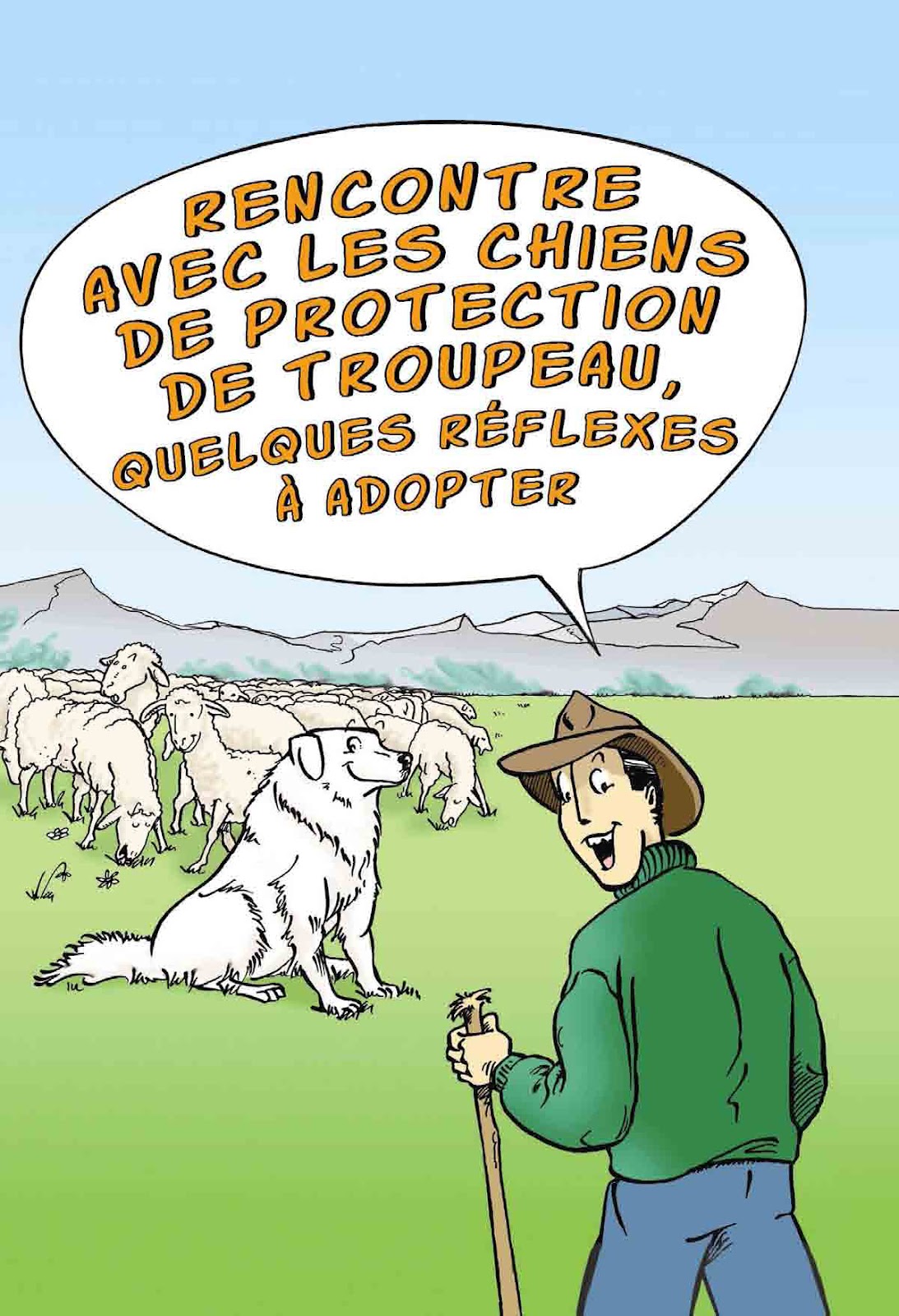
Les gardiens de nos troupeaux. Un film de Paul Aurélien Combre. Produit par Mona Lisa Production. Durée : 9 min. Public : usagers de l’espace rural et montagnard.
Film d’information sur les chiens de protection
"Pour protéger leurs troupeaux contre les prédateurs, les éleveurs et bergers utilisent à nouveau des chiens de protection. Ce ne sont pas des chiens de compagnie, ni des chiens de conduite: ils défendent le troupeau contre toute intrusion en raison de leur fort attachement aux brebis.
De l’hiver autour de la bergerie à l’été en alpage, découvrez leur travail et celui des bergers. Les chiens de protection sont de retour, apprenez à mieux les connaître et adoptez les bons gestes."
Ce film d'information grand public vise à informer les usagers de l'espace pastoral sur la présence et le rôle des chiens de protection des troupeaux domestiques. II apporte quelques conseils simples et essentiels sur les gestes à adopter en leur présence. D'autre part, il présente et valorise le pastoralisme en montagne, et sensibilise les usagers sur le partage de l'espace rural entre activités agricoles et activités de loisirs.
Ce projet documentaire a fait l'objet d'un important travail de concertation conduit par la DREAL et la DRAAF Rhône-Alpes en collaboration avec un comité de pilotage composé : des Fédérations Régionales Ovines du Sud-Est et Rhône-Alpes, l’Assemblée Permanente des Chambres d’Agriculture, du CERPAM, la Maison de la Transhumance, la Société Centrale Canine, l'Institut pour la Promotion des Chiens de Protection (Jean-Marc Landry, expert et consultant), les DDT/ DDTM de l'arc alpin, la DREAL PACA, les ministères de l'écologie et de l'agriculture.
Le film a été tourné tout au long de l’année 2009 dans les Alpes, à Rougon (Alpes de Haute-Provence) et au col de Vars (Hautes-Alpes).
Paru en mars 2010 Disponible en DVD et CD – Format 16/9 – Son : Stereo.
Film réalisé dans le cadre du "plan national d’actions sur le loup 2008-2012 dans le contexte français d’une activité importante et traditionnelle d’élevage"
Version librement téléchargeable et diffusable dans un cadre strictement gratuit
Il n’existe pas en Europe
d’études sur l’impact de la présence de loups sur la fréquentation touristique.
Si certains affirment que le
loup dissuade des touristes, il est probable que l’impact global est plutôt
positif, comme c’est le cas dans certains parcs nationaux américains ou
suédois.
En revanche la présence de chiens
de protection dans les alpages peut inquiéter certains randonneurs qui
préfèreront alors éviter ces zones. Bien que les études menées dans le
Mercantour et le Queyras tendent à prouver que les interactions agressives des
chiens de protection envers les promeneurs sont rares, voire exceptionnelles,
des plaintes sont déposées chaque année par des personnes effrayées par la
présence de ces impressionnants chiens "en liberté" et des cas de
morsures sont parfois observés, souvent liés à une méconnaissance des pratiques
pastorales et du rôle de ces chiens.
Pour réduire les éventuels incidents entre les chiens
de protection et les usagers de l’espace montagnard et rural, des supports
d’information ont été créés à destination du grand public.
Des panneaux de signalisation sont disposés à proximité
des alpages. Ils indiquent la présence de troupeaux domestiques
accompagnés de chiens et la conduite à tenir en leur présence, ainsi que
les règles élémentaires de respect du troupeau, du berger et de son
travail.
Pour compléter ce système d’information, des plaquettes, brochures d’information et affiches
sur les chiens de protection sont distribuées dans différents points
d’information (offices de tourisme, maisons des parcs nationaux, points
d’information des Parcs naturels régionaux....). Elles présentent le
chien de protection, son éducation et son rôle dans les troupeaux
domestiques, et sensibilisent le public randonneur à la conduite à tenir
en leur présence.
Quels Comportements adopter en présence de chien de protection?
Lors de vos randonnées en montagne, vous pouvez rencontrer des
troupeaux de moutons au pâturage. Les chiens de protection sont là pour
les protéger de toute agression. La règle d’or: gardez vos distances avec le troupeau. Le chien de protection n’est pas un chien de compagnie, il ne faut
donc pas essayer de le caresser, de lui donner à manger ou de s’en
approcher pour le prendre en photo. Il n’est cependant pas dressé pour
être agressif mais il est éduqué pour être dissuasif. En arrivant à
proximité d’un troupeau, il peut s’approcher de vous, jusqu’à vous
sentir, parfois en aboyant. Restez calme, laissez-vous renifler,
parlez-lui calmement, évitez les gestes brusques, de le menacer avec un
bâton ou une pierre et évitez de crier.
Contournez le troupeau quand cela est possible plutôt que de le
traverser, même s’il se trouve sur le sentier que vous suivez!
S’approcher trop près du troupeau, tenter de caresser ou de prendre un
agneau dans ses bras peut-être interprété par le chien de protection
comme un acte d’agression envers les animaux qu’ils protègent.
Si vous êtes à vélo, descendez lorsque vous êtes à proximité du troupeau et contournez calmement le troupeau en marchant.
Si vous vous trouvez sur un secteur où les chiens de compagnie sont
autorisés, pensez à les tenir en laisse. Même le plus petit chien peut
partir en courant en direction du troupeau. Le chien de protection
risque d’interpréter cette action comme une tentative de prédation et
s’interposera. Ne portez pas votre chien dans vos bras à l’approche du
chien de protection.
N’oubliez pas que la montagne est aussi un espace de travail. Respecter la quiétude du troupeau, c’est respecter le travail des éleveurs et des bergers.
In many regions of the Iberian Peninsula, wild ungulates have
disappeared and wolves Canis lupus often depend on garbage dumps and domestic
animals. This paper represents an example of wild ungulate preferences of the Iberian wolf
Canis lupus signatus in an environment with no human-wildlife conflicts,
because wolves rarely predate on livestock. I studied the patterns of prey selection by the
Iberian wolf during May 1998-October
2002 in northwestern Spain, in
an area which supports a diverse
community of wild ungulates and in which also domestic ungulates are present.
My analysis of 593 wolf scats showed
that wild ungulates were consumed preferentially over other prey (i.e.
domestic ungulates, carnivores and lagomorphs). Roe deer Capreolus capreolus
was the most important prey species followed by red deer Cervus elaphus and
wild boar Sus scrofa. Domestic ungulates
were poorly represented in the wolf diet. Predation frequencies of domestic
and wild ungulates varied seasonally and
between years. The consumption of roe deer and wild boar increased during
the birthing season, probably because of the higher vulnerability of newly born
animals; wolves predate mainly on juvenile roe deer and wild boar.
Introduction
Most studies on the feeding ecology of
the wolf Canis lupus have been conducted in North America. In Europe, there
have been various studies on wolf diet, some of which showed wild ungulates as
the wolf’s main prey. However, the feeding habits of Iberian wolves Canis lupus
signatus have received little attention and the studies performed have shown
that the species’ food habits are highly
variable depending on the areas in which the species occurs. In many
regions of the Iberian Peninsula, domestic ungulates are of importance, whereas
in other areas, the most relevant prey is wild ungulates. However, the former
studies were fundamentally descriptive, and usually only included data
corresponding to one year. It is not known, therefore, whether and how wolf
feeding habits change over time. Furthermore, the information contained data,
which did not study the age of the selected prey. The trophic ecology of the
Iberian wolf, therefore, remains largely unknown. The aim of my study was to test the hypothesis that the Iberian wolf is
an opportunist species. To test this hypothesis, I predicted that: 1) the wolf consumes the most abundant prey
species and also food which is easier to acquire (i.e. domestic ungulates,
carrion and garbage), 2) the consumption
of prey species varies throughout the year according to prey vulnerability,
so wolves will prey on the individuals and species easier to capture, and 3) for an opportunist species, in a
multiple-prey ecosystem and with high food availability, trophic specialisation
should not be observed over time.
Material and methods
Figure 1. Location of the study area in the Iberian Peninsula.
My study was conducted in the Macizo Central Ourensano in Galicia (northwestern Spain), a mountainous area
that includes the Montes do Invernadeiro
Natural Park (Fig. 1). The study
area, which covers 120 km2 and is part of a larger continuous area (45,829
km2) […] The human population density in
the study area is one of the lowest in the region (0.8 habitants/km2).
Scat analysis and collection
Both prey and prey-age preferences of
the Iberian wolf were assessed from scats
collected systematically every 45 days during May 1998-October 2002. Scats
were collected by surveying roads and firebreaks
in the study area. Faecal marking sites (mainly crossroads) were also included in the search, because the probability of defecation in these
places is greater. […]The date of collection and age of all scats were registered.
Maps with a grid of 1 km2 cells
(Universal Transverse Mercator,UTM) were used to record the scat position. […] Analysis
of scats followed standard procedures. […]
Prey and biomass estimation
The linear regression model used for
ingested prey was y=0.0731+0.00406x (R2=0.84, F=42.4, df=1,8, P=0.0002; derived
from Table 1 in Ruehe et al. 2003),
where y is the biomass ingested (in kg)
per collected scat, and x the average consumed mass (in kg)of an individual of
each prey type.
To estimate
the ingested biomass of domestic and wild ungulates (i.e. roe deer
Capreolus capreolus, red deer Cervus elaphus, wild boar, sheep Ovis aries and goat
Capra aegagrus), the relative proportions of the two age classes ( juvenile
and adult) were taken into account (Table 1). However, to calculate the ingested
biomass of fallow deer Dama dama and mouflon Ovis orientalis, the average mass
for the two age classes was used, because it was impossible to assess the
relative age of the consumed individuals. For carnivores and lagomorphs, the
ingested biomass was calculated considering only the mass of adults.
To determine the densities of wild ungulates (i.e. roe deer, red deer and wild
boar) in the study area, observations of all species were registered along four
transects whose total length was 82 km. […] Goats and sheep are maintained in an intensive system (700 individuals) in the study area, where as cows Bos Taurus and horses Equus caballus are in an extensive system (86 individuals). All domestic and wild ungulates were
potentially available to wolves all year around.
Table 1. Composition of Iberian wolf diet during May 1998 - October 2002 based on 508 scats. The ingested biomass (a in kg) was calculated using body masses only for adults. The birds (b) were not included in the linear regression model, because only mammals were included in the feeding trials. These results were estimated on the basis of the consumed prey mass of an individual prey, which represents x in the biomass equation. The prey mean mass (c in kg) was obtained from Urios 1995, Llaneza et al. 1996, Blanco 1998 and Mateos-Quesada 2002.
Data analysis
I used a hierarchical log-linear analysis
(Backward method) to investigate the effects
of season and year simultaneously on the consumption of domestic and wild
ungulates. […]
Figure 2. Percentage (frequency of occurrence) of two domestic and three wild ungulate species in the Iberian wolf diet per year. The Shannon diversity index (H') and dominance index (D) are calculated per year. In 1998: N=74, in 1999: N=146, in 2000: N=96, 2001: N=78 and in 2002: N=94.
Results
General remarks
A total of 593 scats were used for
dietary analysis. A fraction (10.9%)
of the scats consisted of a combination of soil,
plants and undetermined matter; 6.2% of the scats contained soil and 9.4%
contained B. sylvaticum, but none of these items were considered to be food.
The majority (98.5%) of the analysed
scats contained remains of just one prey
species, and only 1.5% contained
remains of two prey species. Prey species were identified in 87.3% of the scats collected. In terms of biomass,
the types of food identified in the analysed scats were wild ungulates (87.1%
including roe deer, wild boar, red deer, fallow deer and mouflon), domestic ungulates (11.3% including goat and sheep), carnivores (1.1% including dog Canis familiaris, cat Felis catus and badger
Meles meles) and lagomorphs (0.5% rabbit Oryctolagus cuniculus). […]
Figure 3. Percentage (frequency of occurrence) of two domestic and three wild ungulate species consumed per season. The percentage of occurrence for each prey species is based on the total number of scats found per season.
Annual and seasonal patterns
Roe deer was the main prey taken in all years
(Fig. 2). In 2001, the lowest dietary diversity and the highest dominance were
found, taking into account the following prey species: roe deer, red deer, wild
boar, goat and sheep. The highest diversity and the lowest dominance values
corresponded to 1998 (see Fig. 2). Roe
deer was the prey species that was consumed most often in all seasons (Fig.
3), but especially during summer
(52.0%; frequency of occurrence) and
spring (26.2%). The consumption of wild
boar was greater in spring (37.1%) and
autumn (31.0%) than in summer (19.8%) and winter (12.1%). The highest consumption of red deer occurred in
spring (37.4%), followed by autumn (28.1%), winter (26.9%) and summer
(7.6%). The consumption of domestic
ungulates (sheep and goats) also
showed seasonal variation, with consumption significantly higher in spring
(50.0%) and summer (23.8%) than during
autumn and winter. […]
Prey-age preferences
Analysis of bone remains allowed the identification of prey species in 85 of the
119 scats in which they were found. Of the scats, 69.4% contained bone remains
of roe deer, while 27.0%
contained wild boar bones, 2.4% goat/sheep bones and 1.2% red deer bones. Wolves selected juveniles from roe deer and
wild boar populations: 74.1% of roe deer and 82.6% of wild boar whose age
was determined were juveniles (<1 year old).
Discussion
The wolves studied fed mainly on wild ungulates, while domestic
ungulates and other preys (carnivores, lagomorphs and birds) were taken occasionally. In
my study, the consumption rate of wild
and domestic ungulates did not depend on their availability. […]The
presence of livestock remains in wolf scats implies scavenging behaviour,
because no attacks on livestock were reported during my study. Furthermore, in a zone of the study area (Montes do Invernadeiro
Natural Park), horses and cows were kept in an extensive system, but there was
no indication that wolves preyed on them (neither on adults nor on young).
[…]
The scarce
consumption of livestock species in the study area could be correlated with the
high abundance, richness and diversity of wild ungulates […] However, predation on domestic ungulates may remain
high if livestock is locally abundant and the methods of livestock raising are
inappropriate, i.e. the livestock is left unguarded in the countryside. In some regions of the Iberian Peninsula
with high human population densities and scarce wild preys, wolves take
livestock, carrion and even garbage […]
Conclusions
The trophic position of the wolf in the study area is closer to a
facultative specialist than to an opportunist species, because a facultative
specialist may change from a key food item when other profitable prey is
available. Furthermore, it is important to
emphasise that the predation upon roe
deer in the study area could depend on
local feeding specialisation of the studied wolves.
The study of wolf populations inhabiting areas which are only a little
altered by men, and with a high availability of wild ungulates and low human
population densities, provides very valuable information on the wolf diet under
conditions of low human interference. Understanding
the factors related to wolf prey preferences in areas where different potential
prey species coexist is of great use in
reducing the number of attacks on livestock. In areas with low wild ungulate densities, and where
wolves therefore prey on domestic ungulates, reinforcement of wild prey numbers, surveillance of livestock and
limitation of the access to carrion would force wolves to specialise in the
consumption of wild prey and to transmit this behaviour to their offspring.
This would help minimise the conflicts between wolves and humans, which without
doubt would help to guarantee the long-term conservation of the species.
Prey
and prey-age preference by the Iberian wolf Canis lupus signatus in a
multiple-prey ecosystem. Isabel Barja. (2009)http://bit.ly/PI5wjaWildl.
Biol. 15: 147-154 (2009) (Publicado en internet por http://www.wildlifebiology.com/ )
Una interesante entrevista a Isabel Barja (1/11/2009) en el periódico La Región: "El lobo, a pesar de su mala prensa, no busca en las granjas su principal alimento": Entrevista
Se suele creer que el lobo
es intolerante con las actividades humanas, sobre todo cerca de sus madrigueras
y cachorros. En los últimos años, la amplia propagación de esta especie por
la zona alta de los Grandes Lagos ha facilitado el contacto entre el hombre y el lobo. A continuación se detalla el estudio de ciertos lobos que toleran las actividades
del hombre cerca de las madrigueras y de los lugares de reunión con los cachorros.
Algunas de estas actividades son los trabajos de recogida de musgo en el bosque
estatal de Black River (Wisconsin),
las maniobras militares en la Reserva
Militar de Camp Ripley o las obras en la calzada del Bosque Nacional del Lago Superior (Minnesota).
Artículo principal
Hasta hace poco, el lobo (Canis lupus) sobrevivía sobre todo en
territorios vírgenes y llegó a convertirse en un símbolo de la vida salvaje.
Esto se debe principalmente a que los lobos habían sufrido la persecución y el
exterminio en todos los territorios no vírgenes. No obstante, el lobo ha ido regresando durante las
últimas dos décadas a zonas que hacía años que no habitaba, y de esta forma se
ha ido acostumbrando a las actividades del hombre y a las alteraciones que éste
provoca. Ha atravesado, por ejemplo, grandes extensiones de zonas no
forestadas e incluso autovías de cuatro carriles, y en América del Norte suele
merodear por las afueras de los pueblos e incluso matar perros.
Cuando el lobo vivía
únicamente en territorios vírgenes se creía que toleraba muy poco las molestias
causadas por el hombre cerca de sus madrigueras y cachorros, lo cual es posible
que aún suceda en dichos territorios. […]
[…] A medida que la población de lobos se va recuperando en
zonas donde hay mucha actividad humana, los encargados de la administración del
territorio y los directores de recursos aún tienen que decidir si impondrán restricciones sobre la utilización del
suelo en las zonas que están recuperando los lobos. Con frecuencia se ha propuesto prohibir determinadas actividades
humanas a ciertas distancias de las madrigueras y lugares de reunión. […]
No obstante, las
restricciones de la utilización del suelo son muy polémicas y muchos habitantes
de la zona se oponen a ellas incluso por encima de la repoblación de los lobos.
Por ello es necesario documentar la capacidad
de adaptación del lobo a las actividades humanas cerca de las madrigueras y de los
cachorros. Se incluye información sobre casos anecdóticos recientes en los
que el lobo mostraba tolerancia hacia el hombre cuando éste se encontraba cerca
de las madrigueras y cachorros. […]
El lobo se estableció en la parte centro occidental de Wisconsin a principios de la década de los 90.
En 1993, 1994 y 1995 la manada de la zona de Wildcat estableció su madriguera
en el bosque estatal de Black River, en una zona donde se realiza el secado del
musgo de sphagnum por contrata. […]
[…] En Montana, en el
verano de 1994, una manada de lobos vigiló a sus cachorros en un lugar de
reunión a menos de 0,8 Km. de la zona en la que recogían troncos en helicópteros.
[…]
[…] Durante la temporada de cría los lobos de la Reserva Militar
de Camp Ripley, Minnesota, demuestran
una gran capacidad de resistencia.
En esa reserva se entrenan cerca de 40 000 tropas al año, sobre todo en verano,
y la mayoría de estas actividades se realizan en el territorio ocupado por los
lobos. Esto ha ocasionado numerosos encuentros entre los lobos y los humanos,
incluyendo vehículos, el sonido de artillería y la explosión de obuses en las
zonas de impacto. […]Tras 3 años de un
contacto relativamente cercano con los humanos, los lobos de Ripley han
manifestado menos miedo de los humanos de lo que cabría esperar de los lobos en
libertad. […]
[…] En el nordeste de
Minnesota, donde el lobo es especie protegida desde 1974, algunas manadas se
están volviendo muy tolerantes a la presencia del hombre. […]
[…] Estas anotaciones indican el grado de tolerancia que muestran algunos lobos hacia la presencia del
hombre cerca de sus madrigueras y crías, y también lo poco que les cuesta acostumbrarse
a las alteraciones provocadas por el hombre. Si bien es cierto que los
lobos pueden trasladar a sus cachorros como respuesta a las alteraciones
ocasionadas por el hombre, nuestras
anotaciones sugieren que los lobos no trasladan a sus crías largas distancias,
y estas alteraciones no repercuten en la supervivencia de los cachorros.
Tolerancia de los lobos, Canis lupus, en temporada de
preparación de la madriguera a las alteraciones provocadas por el hombre. Thiel, Merrill y Mech. (2000)http://bit.ly/SQkd4sCanadian Field-Naturalist
122(2): 340-342. Versión en español publicada
en internet por http://64.131.82.132/~wolforg/

 Ce projet documentaire a fait l'objet d'un important travail de concertation conduit par la DREAL et la DRAAF Rhône-Alpes en collaboration avec un comité de pilotage composé : des Fédérations Régionales Ovines du Sud-Est et Rhône-Alpes, l’Assemblée Permanente des Chambres d’Agriculture, du CERPAM, la Maison de la Transhumance, la Société Centrale Canine, l'Institut pour la Promotion des Chiens de Protection (Jean-Marc Landry, expert et consultant), les DDT/ DDTM de l'arc alpin, la DREAL PACA, les ministères de l'écologie et de l'agriculture.